There is no other city in Europe quite like it. The Sassi di Matera are not ruins. They are the city itself — carved into the ravine of the Gravina over ten thousand years of continuous human habitation.
The summer heat is unforgiving. The July light on the pale limestone is merciless — flat, white, absolute, offering no shadow and no relief. And then you see the Sassi across the gorge, and none of it matters anymore.
In the 1950s the Italian government forcibly relocated the inhabitants. The cave dwellings were sealed. For decades Matera was an embarrassment — the vergogna d'Italia, the shame of Italy. Then UNESCO came in 1993, and by 2019 — European Capital of Culture — the shame had become a wonder. The trajectory is instructive: what a society calls backward, history eventually recognizes as irreplaceable.
The Sassi — What You're Looking At
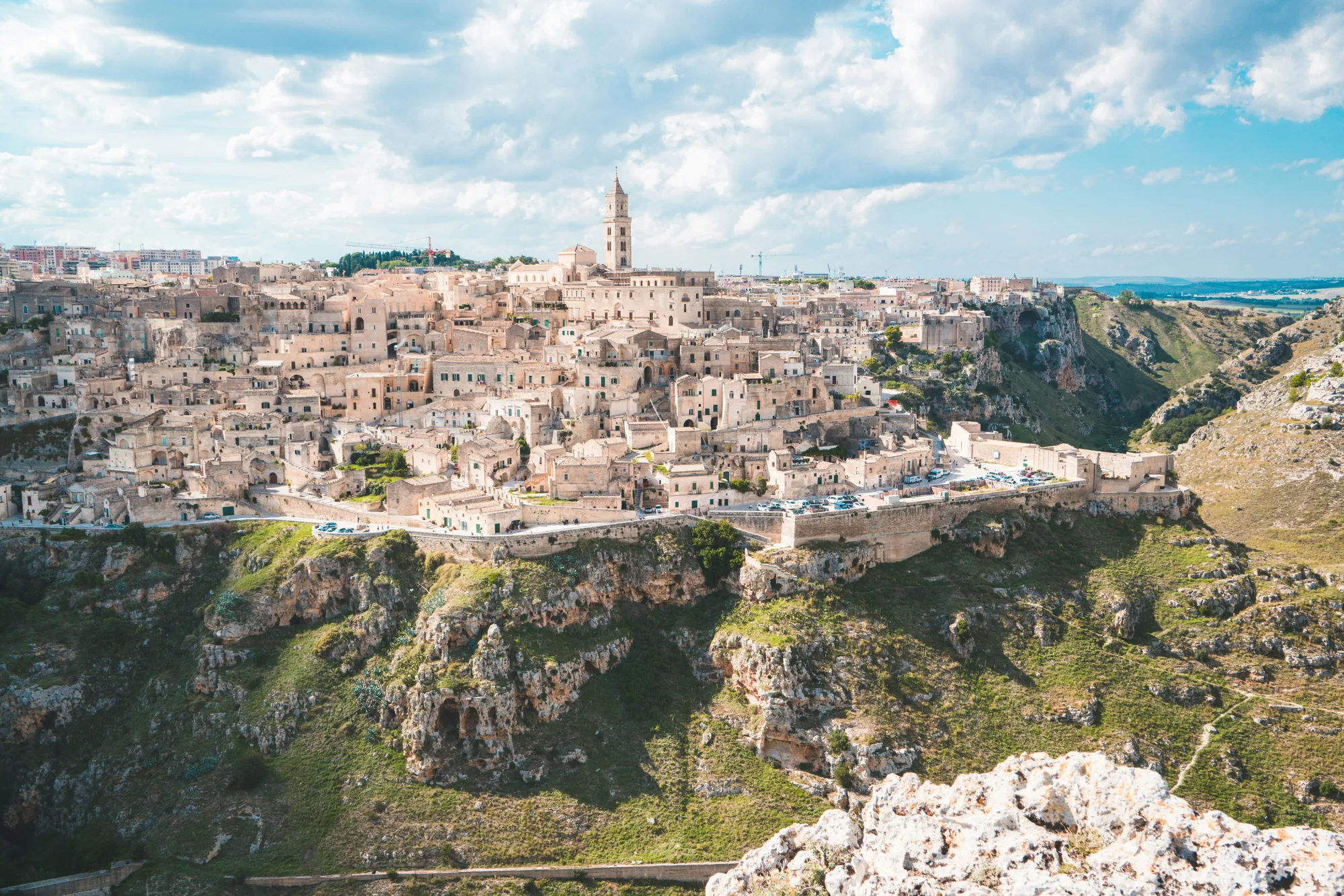
The Sassi di Matera — Sasso Barisano and Sasso Caveoso carved into the Gravina gorge
Matera is divided into two Sassi — the Sasso Barisano to the north and the Sasso Caveoso to the south, separated by a ridge on which the historic city center (la civita) sits. Both are networks of cave dwellings, stairways, and streets carved into the pale limestone over millennia. From the belvedere on Via Bruno Buozzi — the first view most visitors get — the full scale of the thing opens before you: tier upon tier of cave openings, churches, terraces, and ancient cisterns descending into the Gravina gorge.
The Gravina river cuts through the ravine below. On the opposite bank, the Murgia plateau rises — the rock face riddled with cave openings, ancient shepherd shelters, and rupestrian churches that face the Sassi across the void. Walking the Murgia plateau trail (approximately 2 hours) gives you the reverse view: the Sassi seen from below and across, with the geological context the standard belvedere view omits.
Be in the Sassi before 8am. The tour groups arrive around 10. In those two hours, you will have one of the best mornings available to a traveler in southern Italy. The narrow streets channel the early light at acute angles. The cave openings create deep shadow against the illuminated stonework. The absence of people gives you the city as it was.
The Rupestrian Churches — The Most Important Thing You Might Miss
The rupestrian churches of Matera are the most undervisited and most rewarding aspect of the Sassi. These are cave churches carved directly into the rock — some dating to the 8th century, decorated with Byzantine frescoes that survived precisely because they were underground and largely forgotten for centuries.
There are over 150 ascertained rupestrian churches in and around Matera. The most accessible within the Sassi are the Chiesa di Santa Maria de Idris, carved into the cliff face near the Sasso Caveoso (the frescoes here are particularly well preserved), and the Madonna delle Virtù. A combined ticket is available at the visitor center near the Sasso Barisano.
The finest rupestrian painted space in the region — possibly in all of southern Italy — is the Cripta del Peccato Originale (Crypt of Original Sin), located 15 kilometres outside Matera near Picciano. A 9th-century cave church with frescoes so well-preserved the original colors remain vivid — ochre, deep red, Byzantine blue — across an entire cycle of Old and New Testament scenes. It requires a guide and advance booking. It is worth every bit of the effort. Book through the Matera visitor center.
Rupestrian Churches — Practical Notes
When to Go
September and October are the best months. The summer crowds have thinned dramatically, the light becomes extraordinary — lower, warmer, more dimensional — and temperatures are comfortable for walking. The Murgia plateau is at its most beautiful in October.
April and May are equally good — wildflowers on the plateau, mild temperatures, and the tourist season not yet at full pressure. Easter in Matera (the Rites of Holy Week, the Good Friday procession) is one of the most dramatic religious festivals in southern Italy.
July and August are hot and crowded. Manageable if you are disciplined about being in the Sassi before 8am and after 7pm. The Cavalcata di Bruna on July 2 — Matera's oldest festival, a procession and the ritual dismantling of a large wooden float — is worth experiencing if you are there.
Winter is extraordinary and almost entirely overlooked. Matera in snow — the pale limestone Sassi against a white sky, no crowds, the cave hotels warm and intimate — is one of the great travel experiences in southern Italy. January and February rates are a fraction of summer prices.
How to Get to Matera
Getting There
Where to Stay in Matera
Stay in the Sassi. This is not negotiable. The cave hotels are the essential Matera experience — sleeping in a space that has housed human beings for millennia, waking to the silence of the gorge. Book well in advance for summer; the best rooms sell out 3-6 months ahead.
Sextantio Le Grotte della Civita
€€€€ · THE BENCHMARK
Individual cave rooms in the Sasso Caveoso, largely as they were found. Minimal intervention. Stone floors, ancient walls, candles. The most atmospheric accommodation in Basilicata. Book 3-6 months ahead in high season.
Palazzo Gattini
€€€€ · THE POLISHED OPTION
18th-century palazzo converted to luxury hotel with views over the Sassi. More conventionally polished than Le Grotte della Civita. Excellent restaurant. The choice for those who want cave views without cave rooms.
Locanda di San Martino
€€€ · MID-RANGE CAVE
Cave hotel in the Sasso Caveoso offering the essential experience at a more accessible price. Well-located, good breakfast, knowledgeable staff. The best value for the genuine cave experience.
Il Belvedere
€€ · BUDGET PICK
Simple and clean, well-located at the top of the Sasso Barisano with belvedere views. Best value in Matera for travelers on a tighter budget who still want to be in the Sassi zone.
€€ = under €100 · €€€ = €100–200 · €€€€ = €200+. Prices vary significantly by season.
Where to Eat
The tourist restaurants on the main Sassi route are acceptable but overpriced. Walk one street back from the most photographed viewpoints and prices drop significantly while quality improves. The best Matera food is not in the most Instagrammed locations.
Look for restaurants in the upper Sasso Barisano — less traffic, lower prices, and the same quality limestone surroundings. Order anything with lamb (agnello al forno is the definitive Lucanian dish), aged pecorino di Filiano, or peperoni cruschi — the Senise dried peppers that are the most distinctive ingredient in Basilicatan cooking.
The Pane di Matera IGP — twice-ground durum wheat, slow fermentation, wood-fired — is extraordinary. Buy a loaf from a local bakery. It keeps for days and serves as both breakfast and context for the agricultural culture that built this city.
Food & Practical Notes
Matera & the Rest of Basilicata
Matera is the essential entry point to Basilicata — but it is not the whole of it. The region extends south and west into an interior that most Matera visitors never reach: the Calanchi clay ravines of Aliano, the ghost town of Craco, the Dolomiti Lucane, the Aglianico vineyards of Monte Vulture, the wilderness of Il Pollino.
If Matera opens the door, the interior is the house. Spend two nights in Matera and then drive west. The landscape changes within thirty minutes. The crowds disappear within the hour. What you find is something that Matera, for all its extraordinary qualities, cannot quite offer: a landscape that has not been discovered, that does not perform for you, that requires you to come to it on its own terms.
That is the deeper Basilicata. And it is worth the drive.
Frequently Asked Questions
How many days do you need in Matera? +
Minimum two nights, ideally three. One full day for the Sassi, the rupestrian churches, and the belvedere. A second day for the Cripta del Peccato Originale and the Murgia plateau walk. A third day to simply be in the city — the morning light in the Sasso Caveoso before the crowds is worth the extra night.
What is the best area to stay in Matera? +
Stay in the Sassi — either the Sasso Caveoso or the Sasso Barisano. The cave hotels are the essential Matera experience. Sextantio Le Grotte della Civita is the benchmark. For mid-range, Locanda di San Martino in the Sasso Caveoso offers the essential cave experience at a more accessible price.
When is the best time to visit Matera? +
September and October are ideal — the summer crowds have thinned, the light is extraordinary, and temperatures are comfortable. April and May are equally good. Winter is extraordinary and entirely overlooked — Matera in snow, with no crowds, is one of the great travel experiences in southern Italy.
What are the rupestrian churches of Matera? +
Cave churches carved into the limestone rock, dating from the 8th to 13th centuries, decorated with Byzantine frescoes that survived underground for centuries. The most accessible are Santa Maria de Idris and Madonna delle Virtù in the Sassi. The finest example is the Cripta del Peccato Originale, 15km from Matera — book in advance.
Is Matera expensive? +
More expensive than most of Basilicata, but significantly cheaper than comparable UNESCO sites in northern Italy. Cave hotel rooms range from €80 to €400+. Restaurants in the Sassi are tourist-priced — walk one street back from the main route for significantly better value. Winter rates are a fraction of summer prices.
Is Matera worth visiting? +
Yes — unconditionally. There is no other city in Europe quite like it. Ten thousand years of continuous human habitation in a single ravine. Byzantine frescoes underground. Cave hotels. The Gravina gorge. The early morning light before the tour groups arrive. It is one of the most extraordinary urban experiences in Italy. Go.