The silence has the weight of history. Not the comfortable silence of a countryside afternoon — something older and more deliberate. The silence of a place that stopped mid-sentence and never found its way back.
Craco was evacuated in 1963. A landslide had been threatening the medieval village for years — the clay subsoil that underlies much of the Basilicatan interior, unstable after centuries of erosion, finally gave way beneath the Norman-era streets. The residents were given notice and told to go to Craco Peschiera, a new settlement built for them in the valley below. They left. The buildings stayed.
What you walk through now is not ruin in the conventional sense. It is interruption. A town mid-sentence. The streets are still streets. The church still has its nave — and growing where the altar once stood, a green bush that found sufficient ground in the rubble and decided this was adequate. The Norman bell tower, built in the 11th century, stands solid after a thousand years while more recent construction crumbles around it. You understand something about the difference between building for permanence and building for convenience.
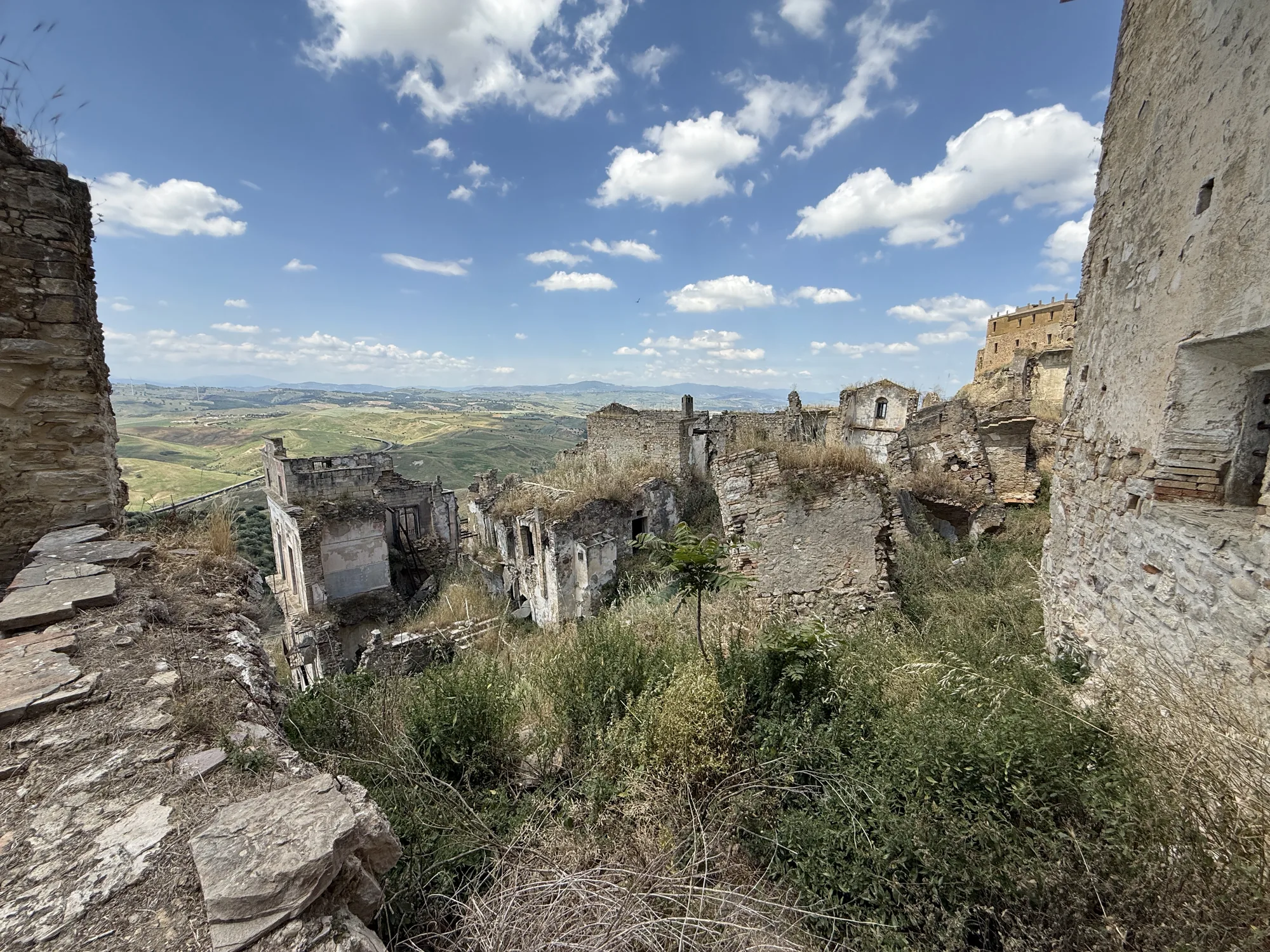
Craco from below — the full silhouette of the abandoned village against the Basilicatan hillside
Important: Craco cannot be visited without a guide. The village is structurally unstable in places and access is strictly controlled. All visits must be booked in advance through the ProCraco association at procraco.it. Do not attempt to enter independently — both legally and physically, it is not safe.
The History of Craco
Craco's origins are ancient — the site shows evidence of habitation from the 8th century BC, and the medieval settlement that gives the town its current form dates to the Norman period of the 10th and 11th centuries. The name appears in documents from 1060, when Archbishop Arnaldo of Tricarico described it as a significant settlement in the Basilicatan interior.
The village occupied a strategic position: a defensible ridge rising 391 metres above the Cavone river valley, with views across the Basilicatan interior that made it almost impossible to approach undetected. This defensibility was the logic of settlement throughout the Lucanian interior — villages built high, built tight, built to see threat coming. The same logic that put Craco on its ridge eventually made it vulnerable to the geological forces working beneath it.
The great emigration of the late 19th and early 20th centuries had already reduced Craco's population significantly before the landslide made the question moot. Between 1880 and 1915, thousands left for the Americas — Argentina, Brazil, the United States — following the same routes as emigrants from across the Basilicatan interior. The village that the landslide evacuated in 1963 was already a shadow of what it had been at the turn of the century. The landslide simply gave the abandonment a clean date.
What You See Inside
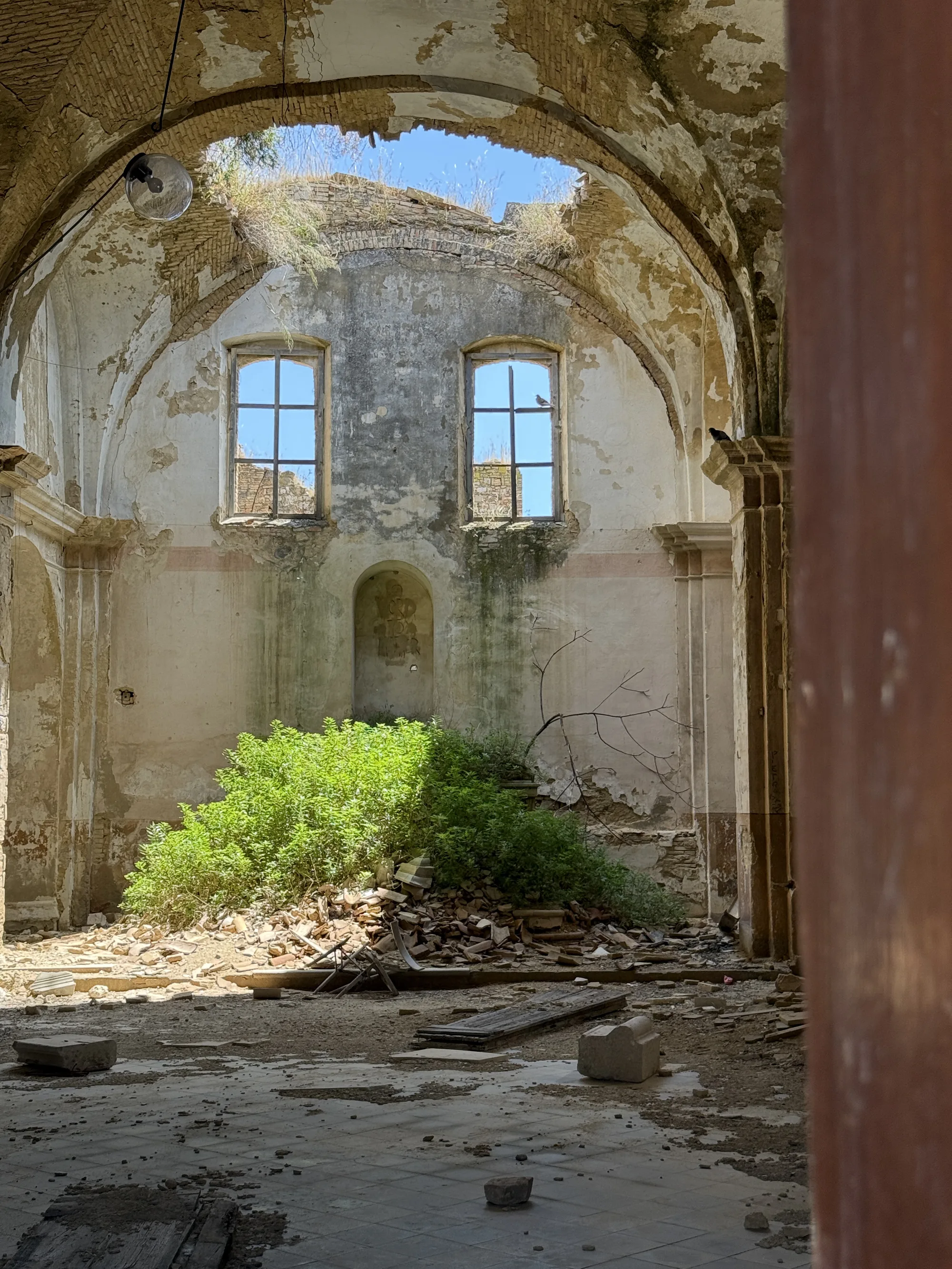
The church interior — bush growing where the altar stood
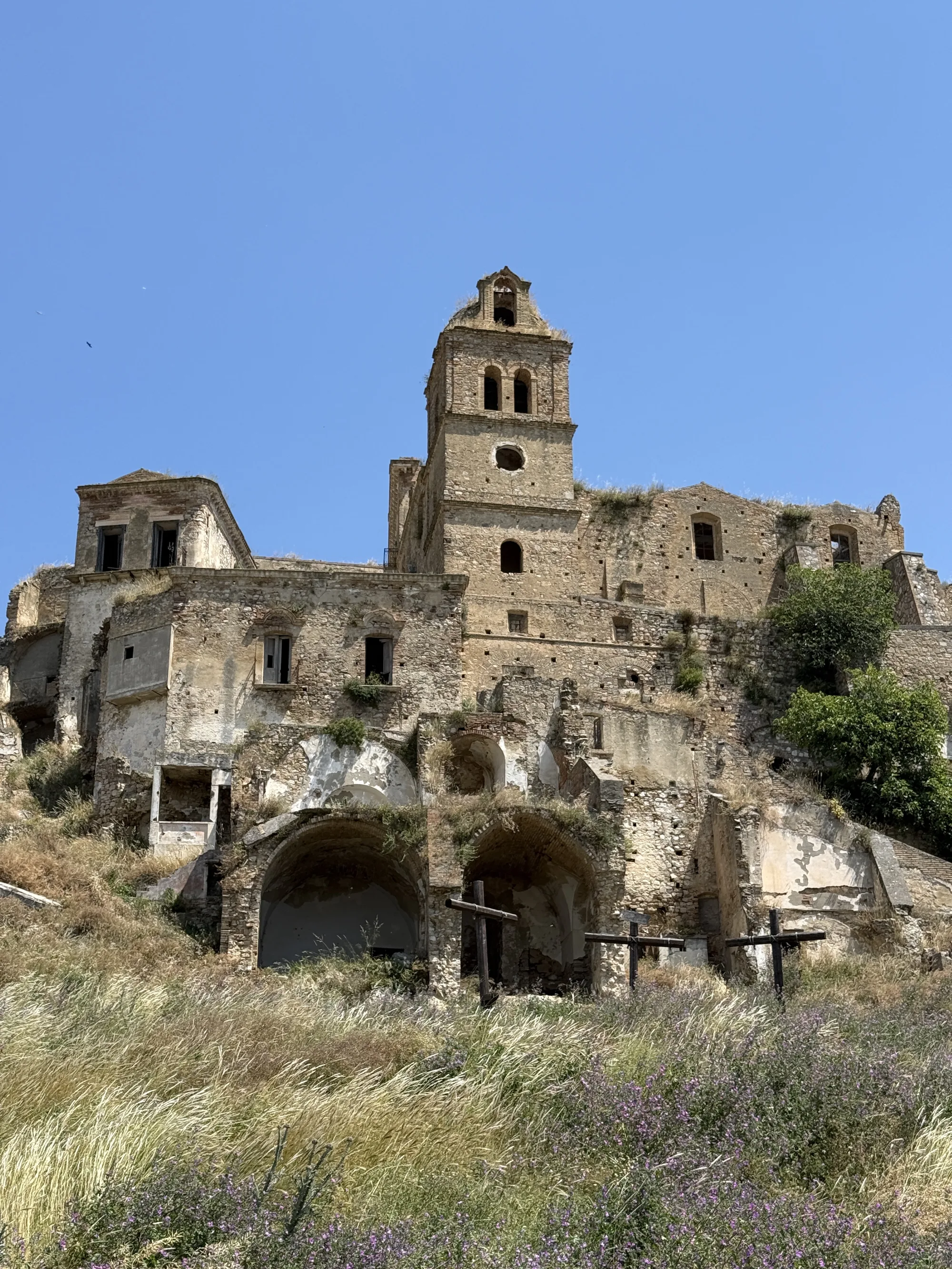
The Norman bell tower — 11th century, still standing
The guided walk takes approximately 90 minutes and covers the main thoroughfare, the principal piazza, the church of Santa Maria della Stella, the palazzo of the local noble family, and the Norman bell tower. Your guide will explain the structural condition of each building and the history of the abandonment.
The church is the most affecting space in Craco. The roof collapsed years ago, leaving the nave open to the sky. In the apse where the altar once stood, a green bush has established itself in the rubble — a patient, indifferent reclamation that proceeds at the pace of years rather than human urgency. Two birds were perched in the upper arch when I visited. They watched with the mild curiosity of long-term residents.
The palazzo courtyard is the most dramatically architectural space — three walls still standing at full height, the fourth open to the valley behind. The decorative stonework intact. Standing here, you are inside someone's home. Someone's life. The center of someone's world, abandoned in a single season and left to the light and the grass.
The Norman bell tower tells the architectural story most clearly. The 11th-century stonework at the base is solid, precisely fitted, built by craftsmen who understood that stone placed correctly would outlast everything. The 19th-century additions above show the difference — cheaper construction, faster degradation, already returning to constituent parts while the Norman foundation stands indifferent.
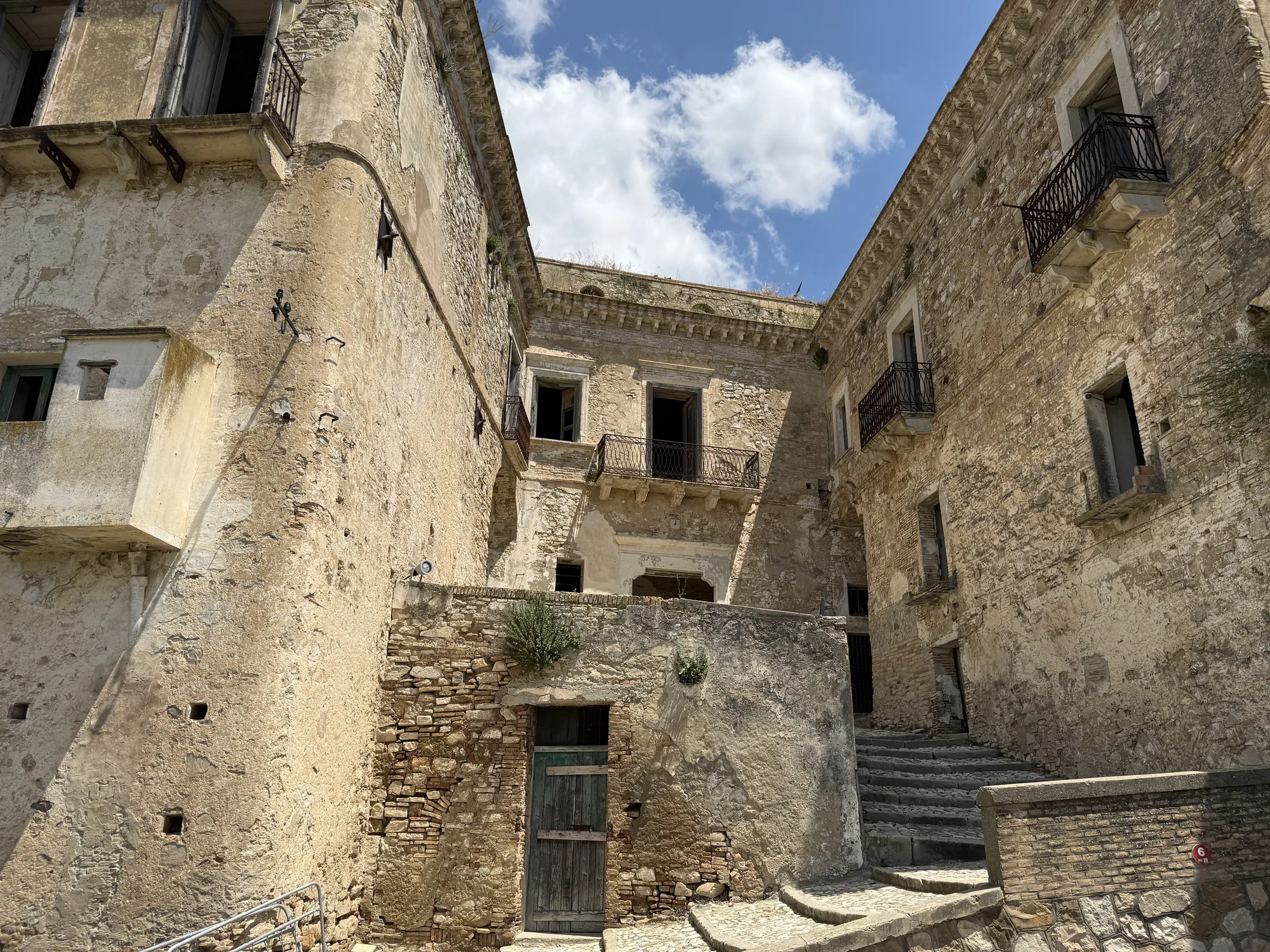
The palazzo courtyard — three walls, open sky
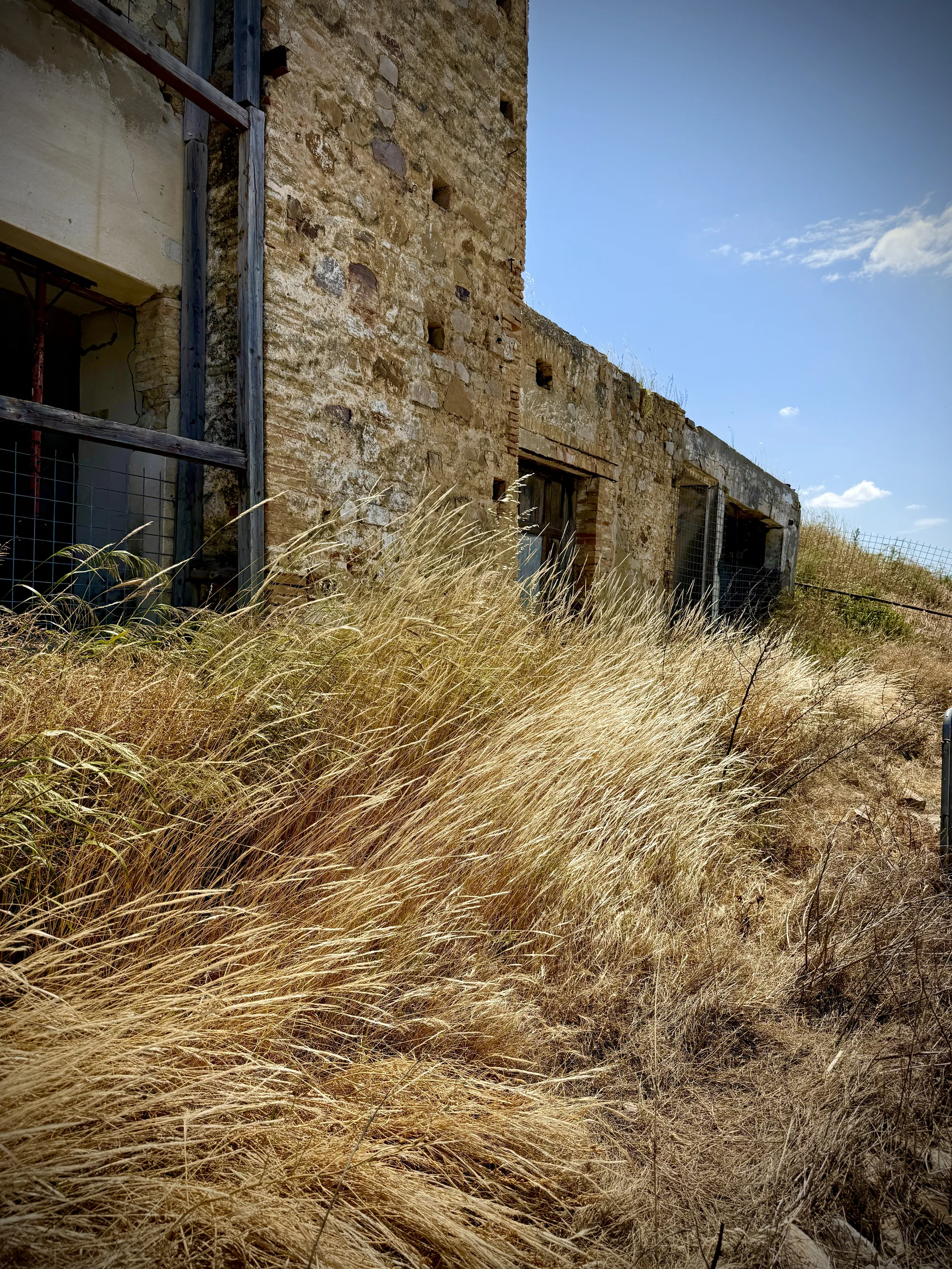
The grass reclaiming sixty years of silence
How to Visit Craco — Complete Practical Guide
Booking Your Visit
Getting to Craco
Photography Notes
Craco on Film
Craco has appeared in several major film productions — chosen specifically because its atmospheric ruins and dramatic landscape could not be replicated on a studio set.
The Passion of the Christ (Mel Gibson, 2004) used Craco extensively for exterior scenes. Gibson chose the location precisely for its ancient, unreconstructed quality — the worn stone, the collapsed buildings, the landscape that seemed to belong to a different age entirely. The Craco footage from this film is the best visual document of the village before further deterioration.
Quantum of Solace (Marc Forster, 2008) used Craco for the opening action sequence. The contrast between the contemporary film production and the medieval ruins was part of the visual language of the scene — modernity moving through a space that predated it by centuries.
Several Italian productions have also used Craco, and the village has appeared in documentary work on southern Italian history and the phenomenon of abandonment that characterizes the Basilicatan interior. None of this film work has fully captured what it is to stand in the village — the weight of it, the silence, the specific quality of a place that stopped. That requires being there.
What Craco Means
Each abandoned settlement in Basilicata is a document. Craco is that document preserved in amber by a landslide — given a clean date, a clear before and after, a narrative tidiness that the slow drift of depopulation does not provide.
But the story Craco tells is not just the story of a landslide. It is the story of the great southern emigration — the half of the Basilicatan population that left between 1880 and 1940 for the Americas and northern Europe. The villages they left behind began emptying before the landslides came. The landslides simply completed what poverty and opportunity had started.
Standing in the palazzo courtyard, looking at three walls that once enclosed a life, you are not looking at disaster. You are looking at decision — the accumulated individual decisions of thousands of people who concluded that somewhere else offered something this place could not. The bush at the altar is not tragedy. It is simply what happens when humans stop, and life continues on its own terms.
That is what Craco asks you to sit with. And it is worth sitting with for longer than the 90-minute tour allows.
Nearby — Complete the Day
Aliano & the Calanchi
45 MIN FROM CRACO
The clay ravines where Carlo Levi was exiled. The Museo Carlo Levi. The tomb at the edge of the ravines. The other great document of the Basilicatan interior.
Read the Essay →Matera
45–60 MIN FROM CRACO
UNESCO cave city. Ten thousand years of continuous habitation. The essential Basilicatan experience. Stay at least two nights in the Sassi.
Full Guide →Pisticci & Tursi
30 MIN FROM CRACO
Hill towns sharing Craco's quality of endurance without the tourist infrastructure. Pisticci is one of the most dramatically sited towns in Basilicata. Almost nobody goes.
Territory Guide →Frequently Asked Questions
Can you visit Craco independently? +
No — Craco cannot be visited without a guide. The village is structurally unstable and access is controlled by the ProCraco association. All visits must be booked in advance at procraco.it. Do not attempt to enter independently.
How do I book a guided tour of Craco? +
Book online at procraco.it. Tours typically run at 10am, 12pm, and 4pm in high season. Book at least 24-48 hours in advance — morning slots sell out first. Request an English-speaking guide when booking if needed.
Why was Craco abandoned? +
Craco was evacuated in 1963 following a landslide that destabilized the medieval village. 1,800 residents were relocated to Craco Peschiera in the valley below. Further landslides in the 1970s and an earthquake in 1980 confirmed the original site could not be reoccupied. The buildings have been left largely as they were.
What films were made in Craco? +
The Passion of the Christ (Mel Gibson, 2004) and Quantum of Solace (2008) both used Craco as a filming location. Several Italian productions have also been shot there. The Passion of the Christ footage provides the best visual document of the village.
How far is Craco from Matera? +
Approximately 45-60 minutes by car. Take the SS407 Basentana toward Taranto, exit at Montalbano Jonico, then follow signs to Craco Peschiera. A car is essential — there is no public transport to Craco.
Is Craco worth visiting? +
Yes — unconditionally, for the traveler who wants depth over convenience. Craco is not conventionally beautiful. It has weight — the specific gravity of a place that stopped mid-sentence. The church with the bush at the altar. The palazzo courtyard open to sky. The Norman bell tower solid after a thousand years. It stays with you long after you leave.