In 1904, a young man named Agostino Coppola left Bernalda and boarded a ship for America. He took the memory of the town with him — calling it, for the rest of his life, Bernalda bella. A hundred years later, his grandson came back to finish the story.
Bernalda is a walled hilltop town in the province of Matera, founded in the 15th century, sitting above the flat agricultural plain that runs toward the Ionian coast. It is not a famous place. It does not appear in most Basilicata itineraries. It has no UNESCO designation, no particular drama of landscape, no ghost town or ancient ruin to draw visitors. What it has is the specific quality of a southern Italian town that has remained itself — the palm-lined Corso Umberto, the unhurried pace, the evening passeggiata, the sense that the rhythms here predate the machinery of modern tourism entirely.
And it has Palazzo Margherita.
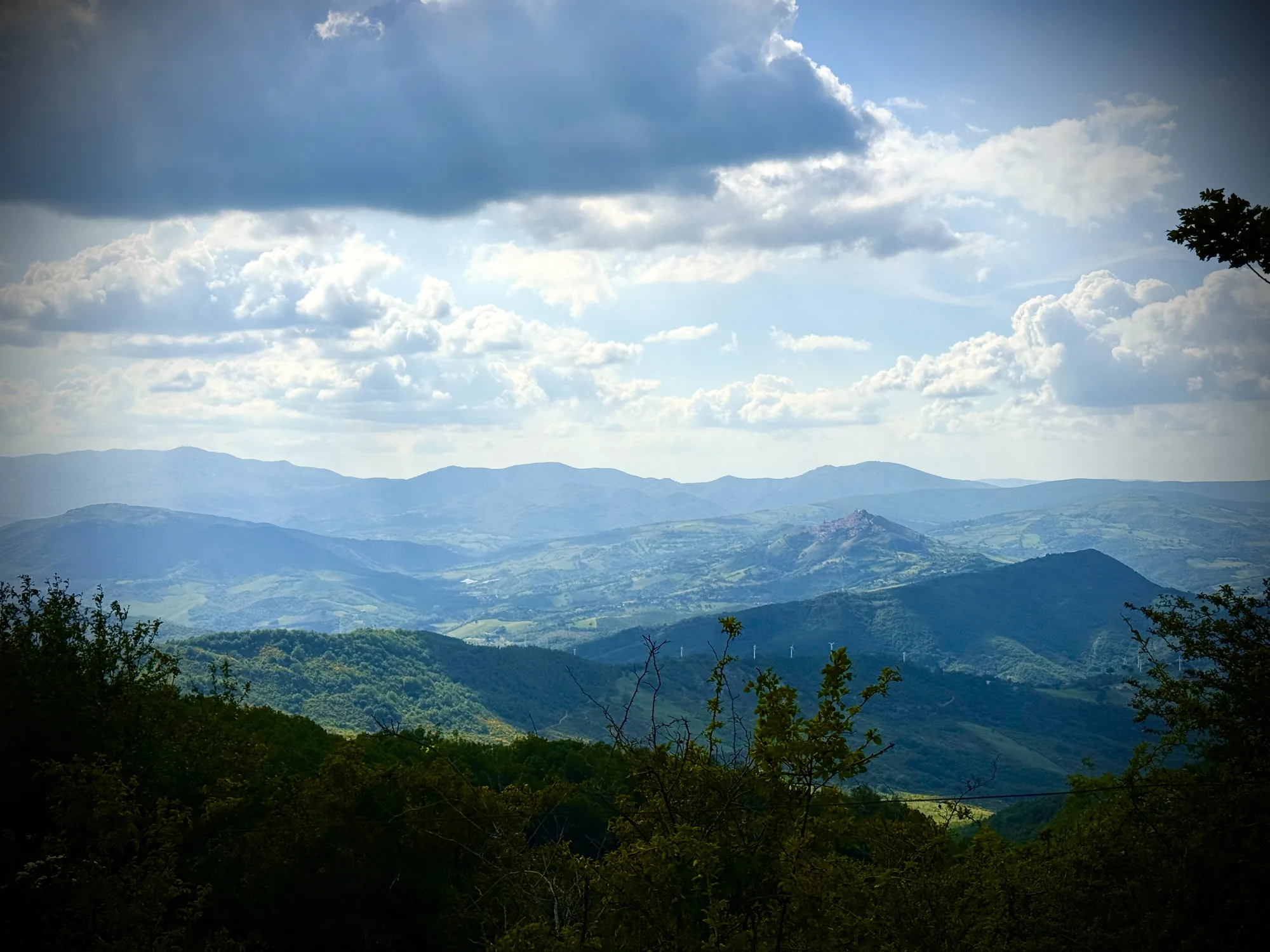
The Basilicatan interior near Bernalda — between Matera and the Ionian coast
The Coppola Connection
Agostino Coppola — Francis Ford's grandfather — was born in Bernalda and emigrated to the United States in 1904. The journey he made was the same journey made by hundreds of thousands of Basilicatans in the same decades: out of poverty, out of the south, toward the promise of the New World. The film that made his grandson famous, The Godfather, is at its core a story about that emigration — Vito Corleone's flight from Sicily, the violence and displacement and reinvention that followed. It is not difficult to imagine what Agostino's story meant to the grandson who told it, in different form, on screen.
"Every town had a Podestà, the official of the fascist party, and this family was the Podestà. The ladies here were so snobby. We are low-class Italians; they were more high-class Italians."
— Francis Ford Coppola, speaking to Anthony Bourdain about Bernalda and Palazzo MargheritaCoppola purchased Palazzo Margherita in 2004. The palazzo had been built in 1892 by the Margherita family — the same family his grandfather's family had looked up at from below, the high-class Italians whose palazzo loomed over the low-class town. The purchase was not simply a hotel investment. It was a reversal of fortune one hundred years in the making. The low-class Coppolas, through the strange alchemy of American cinema, had come back to own the palazzo of the snobs.
The restoration took years. Coppola worked with French designer Jacques Grange to convert the decaying building into nine suites while preserving the palazzo's original character — frescoed ceilings, period furniture, the historic garden. The result is something that sits between a luxury hotel and a private house, staffed almost entirely by people from local Bernalda families, managed with the specific warmth that comes from genuine attachment to a place rather than corporate hospitality protocol.
Palazzo Margherita — What It Is
Nine suites. That is the scale of it. Three suites open onto the garden. Others have balconies overlooking the slow-paced village life of Corso Umberto. Each room was designed individually — some by members of the Coppola family, each carrying a distinct character. The overall effect is of a private residence that happens to accept guests rather than a hotel that has been styled to feel personal.
The rates include breakfast, in-room drinks, and cooking classes with the palazzo's kitchen team — classes focused on traditional Lucanian cuisine using organic produce from the hotel's own gardens. There is a cinema salon dedicated to Italian neorealist film, stocked with classics, designed explicitly as a screening room. The minimum stay is two nights. The staff, led by general manager Rossella De Filippo, operates the palazzo with the unhurried hospitality that the pace of Bernalda itself seems to require.
It received One MICHELIN Key in 2024 — the Guide's designation for hotels that offer a particularly special stay.
Palazzo Margherita — Practical Information
Bernalda — The Town Itself
Beyond the palazzo, Bernalda is a town worth understanding on its own terms. The Corso Umberto is lined with palm trees — a remnant of the Bourbon period when the south was under Neapolitan rule and palm trees were fashionable signifiers of southern Mediterranean identity. The historic center is compact and walkable, the churches modest and unrestored in the way that characterizes towns that have not been reorganized for tourism.
The town sits above the Bradano river valley, with views south toward the Ionian plain. The coast at Metaponto is fifteen minutes by car — and Metaponto is itself one of the most undervisited sites in southern Italy: the ruins of Pythagoras's adopted city, the Temple of Hera rising from the plain above miles of near-empty Ionian beaches. The combination of Bernalda and Metaponto in a single day — town in the morning, Greek ruins and sea in the afternoon — is one of the quietly perfect itinerary combinations in Basilicata.
Matera is 35 minutes northwest by car. The Calanchi and Aliano are 45 minutes west. Craco is an hour south. Bernalda sits geographically at the center of the eastern Basilicatan experience — the logical base for someone who wants to move through the region rather than being anchored in Matera.
The Emigration Story
What makes Bernalda interesting beyond the Coppola connection is what it represents in the larger narrative of Basilicata. The emigration of 1880-1940 — the half of the region's population that left for the Americas, for Germany, for the factories of the north — is the defining event of modern Basilicatan history. It is why villages like Aliano and Craco ended up as small and isolated as they did. It is why the region feels, even now, like a place that has been holding its breath.
Agostino Coppola's departure in 1904 was not exceptional. It was ordinary — one of thousands of similar departures from similar towns in the same decade. What was exceptional was the return. Most emigrant families did not return to restore the palazzos of the families they had once served. The Coppola story is not a story of roots in the sentimental sense — it is a story of displacement, reinvention, and the specific American trajectory that turned low-class Lucanian emigrants into one of the most celebrated filmmaking dynasties in cinema history.
That trajectory is legible in the palazzo itself. The frescoed ceilings were painted for the Margherita family. The garden was laid out for the Margherita family. Agostino Coppola looked at this building from the street and knew, in the way that everyone in a small southern Italian town knows, exactly who owned it and what that meant. His grandson now owns it. The story Basilicata tells, if you are paying attention, is full of reversals like this one.
How to Fit Bernalda Into Your Itinerary
Bernalda works best as a base for 2-3 nights in the eastern part of Basilicata — a quieter, more intimate alternative to staying in Matera. From Bernalda you can reach Matera in 35 minutes (day trip, arrive before 8am, return for dinner), Metaponto in 15 minutes (morning ruins, afternoon beach), the Calanchi and Aliano in 45 minutes (morning walk, Museo Carlo Levi, lunch), and Craco in approximately one hour.
If Palazzo Margherita is outside your budget, Bernalda has smaller B&Bs and guesthouses that offer the same geographic advantages at a fraction of the price. The town itself — the passeggiata, the local bars, the rhythm of an ordinary Basilicatan afternoon — is available to everyone regardless of where they sleep.
Metaponto
15 MIN FROM BERNALDA
Magna Graecia ruins, Temple of Hera, Ionian beaches. Pythagoras lived and died here. Combine with Bernalda in a single day.
Territory Guide →Matera
35 MIN FROM BERNALDA
UNESCO Sassi cave city. 10,000 years of habitation. The essential Basilicatan experience. Day trip from Bernalda.
Full Guide →Aliano & Calanchi
45 MIN FROM BERNALDA
Carlo Levi's exile. Clay ravines of extraordinary beauty. Museo Carlo Levi. The literary heart of Basilicata.
Read the Essay →Frequently Asked Questions
What is Francis Ford Coppola's connection to Bernalda? +
Bernalda is the ancestral home of Coppola's grandfather, Agostino Coppola, who was born in the town and emigrated to the United States in 1904. Agostino called it "Bernalda bella" for the rest of his life. Francis Ford Coppola purchased Palazzo Margherita in 2004 and restored it as a boutique hotel — returning his family's story to the place where it began.
What is Palazzo Margherita? +
A 19th-century palazzo in Bernalda purchased by Francis Ford Coppola in 2004 and restored into a 9-room luxury boutique hotel. Awarded One MICHELIN Key. Rates include breakfast, in-room drinks, and cooking classes. Minimum two nights. Book at thecoppolahideaways.com.
How far is Bernalda from Matera? +
Approximately 35 minutes by car — about 35 kilometres. Bernalda sits between Matera and the Ionian coast, making it an excellent base for exploring both the interior of Basilicata and the beaches of Metaponto (15 minutes away).
Is Palazzo Margherita worth the price? +
It is one of the most distinctive small hotels in southern Italy — a genuine labor of love with nine individually designed suites, a historic garden, and staff from local Bernalda families. For travelers drawn by the Coppola story and the quality of the restoration, it is worth it. For travelers focused primarily on value, Matera offers excellent alternatives at lower price points.
Is Bernalda worth visiting without staying at Palazzo Margherita? +
Yes — the town itself has the quality of an unperformed southern Italian life: the palm-lined Corso Umberto, the passeggiata, the ordinary rhythm of a place that has not been reorganized for tourism. Combined with Metaponto fifteen minutes away, it makes for a quietly extraordinary day. You don't need to stay in the palazzo to understand what Coppola saw.