The village sits above the ravines as if placed there deliberately — at the precise point where the land runs out of patience and drops into pale clay. The Calanchi have been forming for five million years. They will still be forming long after the village is gone.
Aliano is known for two things that are, in a sense, one thing: Carlo Levi and the Calanchi. The writer and painter who came here as a prisoner in 1935 and the landscape that surrounded him are inseparable in the imagination of anyone who has read Christ Stopped at Eboli. Levi saw the ravines as the defining feature of the Lucanian interior — not backdrop but protagonist, a landscape that predated and would outlast the human story playing out on its surface.
He came as a prisoner. He left as a witness. The book he wrote from memory eight years later — in a different city, during a different war — is one of the most extraordinary documents of Italian conscience, and it made this village of a thousand people known to readers in thirty languages.
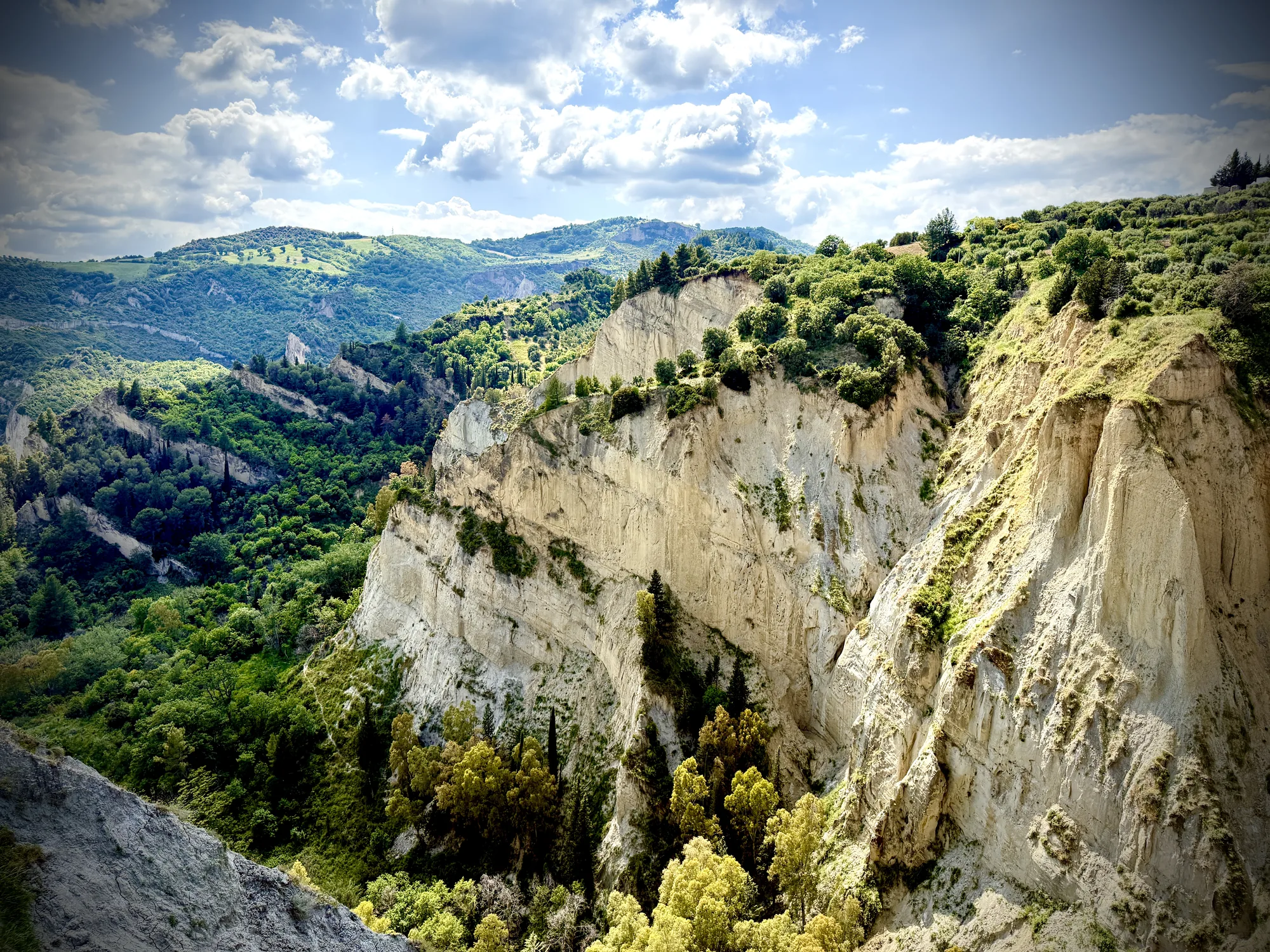
The Calanchi of Aliano — five million years of erosion, pale ochre clay, early morning light
"We were far from everywhere, lost in a world without end, in a gray and motionless sea of clay, under a gray and motionless sky."
Carlo Levi — Christ Stopped at Eboli, 1945
The Calanchi — What You're Looking At
The Calanchi are clay badlands — marine sediment laid down when this part of southern Italy was seabed, exposed by tectonic uplift and sculpted by millions of years of rain into a landscape of pale ridges, ravines, and pointed pinnacles. They are one of the most geologically distinctive features in Italy and one of the least known to non-Italian travelers.
The color is the first thing. Not the grey that Levi described — that was the grey of winter and melancholy — but in summer light, a warm ochre that shifts through the day from pale gold at dawn to almost white at midday to deep amber in the afternoon. After rain, the clay darkens to something closer to the landscape Levi was looking at: heavy, lunar, indifferent.
The best time to see the Calanchi is the first hour after sunrise. The low sun comes from the east and rakes across the ridges at an acute angle, defining every erosion channel and pinnacle in sharp relief. By mid-morning the light flattens and the ravines lose their drama. Bring water. The trails are well-marked but there is no shade.
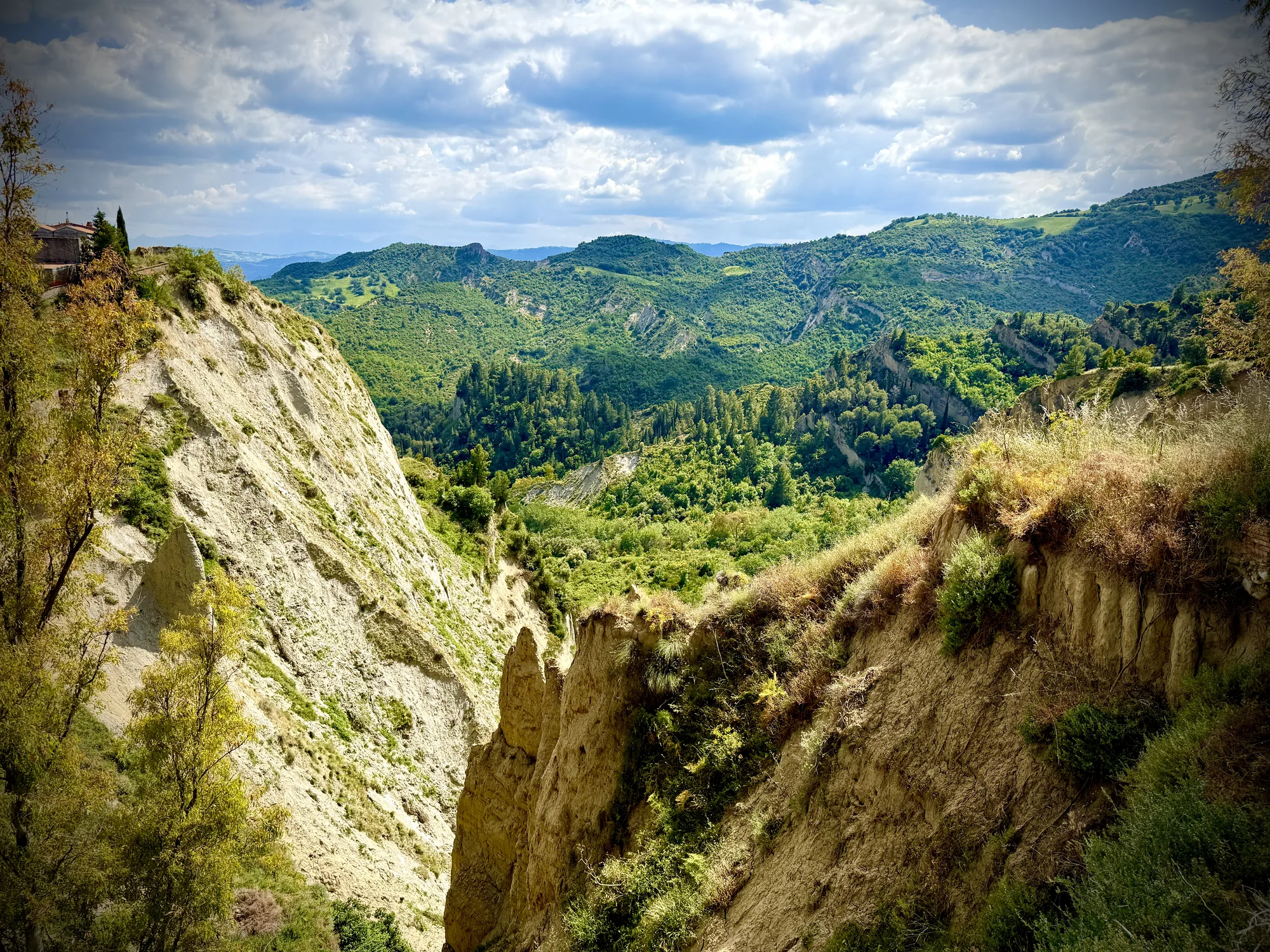
The village above the ravines — Aliano perched at the edge
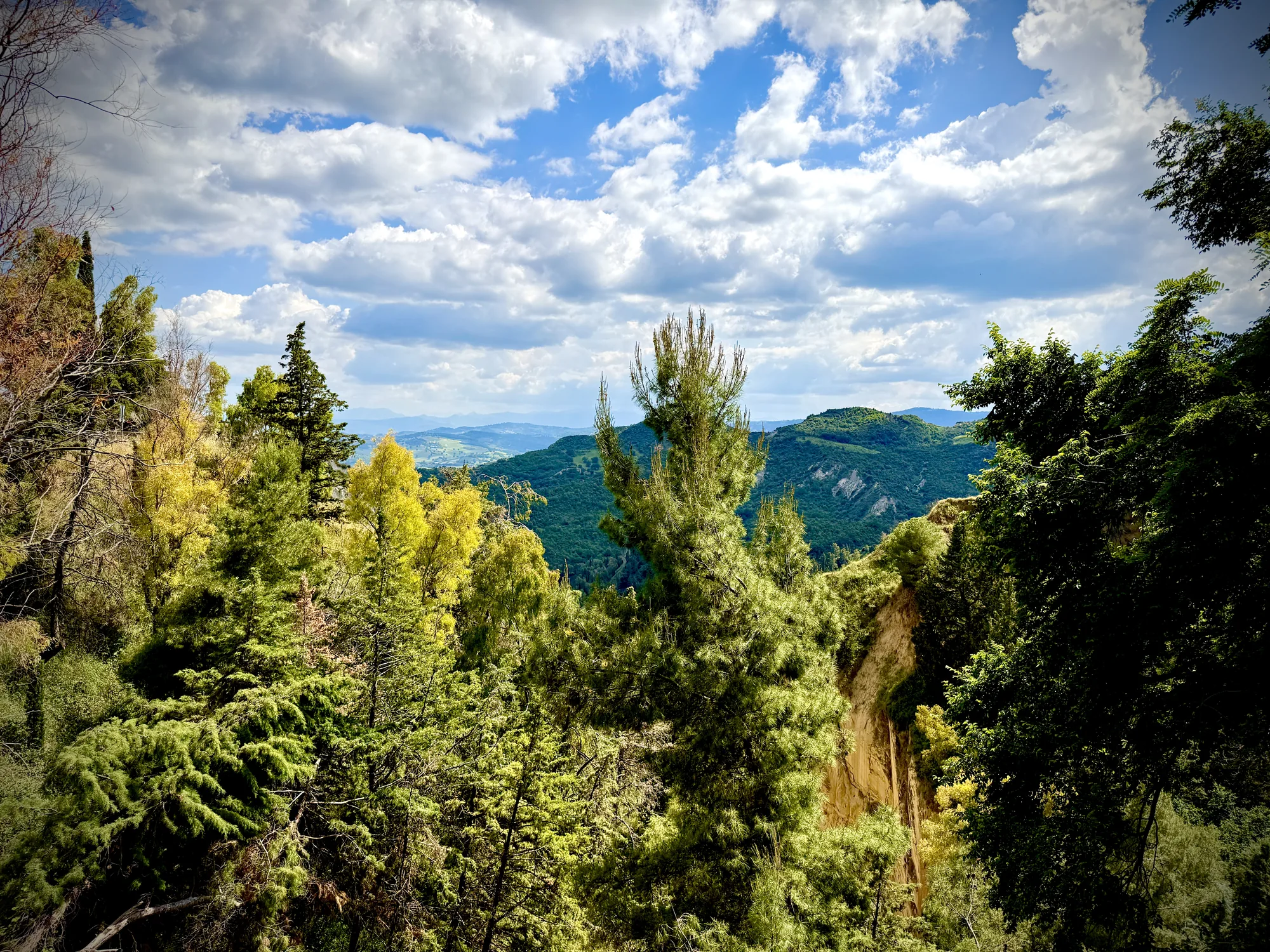
The erosion channels — five million years of patient work
Walking the Calanchi
Carlo Levi — Why He Matters Here
Carlo Levi (1902–1975) was a Turin physician, painter, and antifascist activist who was sentenced to internal exile — confino — by Mussolini's government in 1935 for his political activities. He was first sent to Grassano and then transferred to Aliano, which he called Gagliano in his memoir to protect the identities of the people he wrote about.
He was thirty-three years old. He had never been to the deep south. He knew the sophisticated culture of Turin, of Paris, of the Italian antifascist underground. What he found in Aliano was a world that had developed on entirely different terms — a peasant culture with its own relationship to time, magic, illness, and the state; a landscape that operated according to geological rather than human rhythms; a community that had been practicing a form of existence that modernity had not yet reached, and was not certain it wanted to.
He practiced medicine informally — the village had no doctor — and painted constantly. His portraits of the Aliano peasantry are direct, unromanticised, painted with thick impasto and absolute attention: faces shaped by physical labour and exposure, bodies that had been doing the same things for generations. They hang now in the Museo Carlo Levi in the Palazzo Lucan, where Levi lived during his confinement.
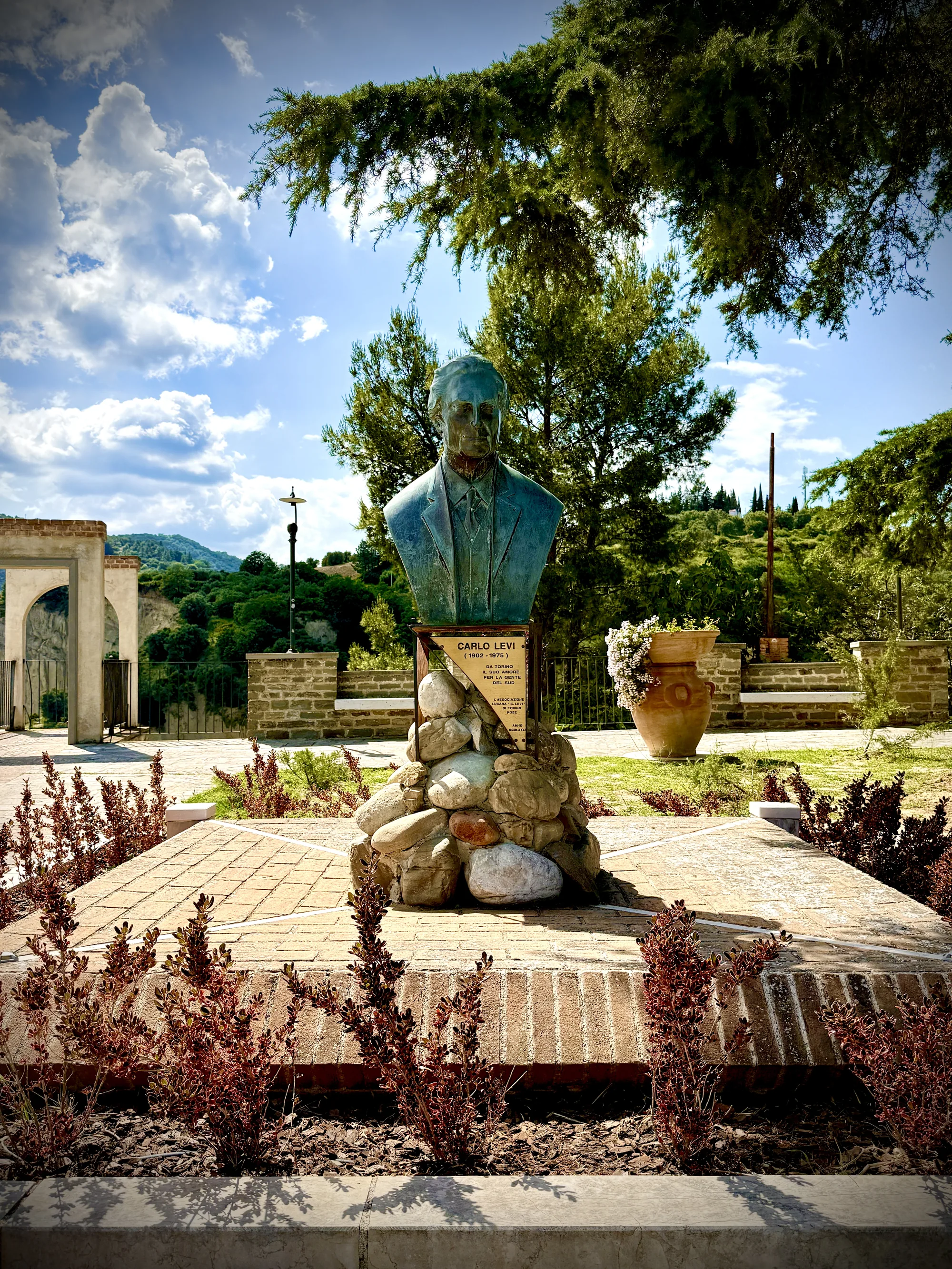
The Carlo Levi memorial — "Da Torino, a suo amore, per la gente del Sud"
He wrote Christ Stopped at Eboli in 1943–44, in hiding in Florence during the German occupation. He wrote the entire book from memory — no notes, no diary — in approximately eight months. It was published in April 1945, the month of Italy's liberation, and became an immediate and lasting success.
The title comes from a phrase he heard repeatedly from the Aliano peasants. Christ — by which they meant civilization, history, the state, modernity, and Christianity itself in its institutional form — had stopped at Eboli, on the Campanian plain south of Naples. Beyond Eboli was a different world, older than Rome, indifferent to the categories that organized Italian national life. This was not complaint. It was description.
Levi requested burial in Aliano. His tomb stands at the edge of the Calanchi — facing the landscape he spent two years learning to see — in the village cemetery above the ravines. The inscription on the monument in the village garden reads: "Da Torino, a suo amore, per la gente del Sud." From Turin, with his love, for the people of the South.
What to See in Aliano
Key Sites
Where to Eat in Aliano
Aliano is a village of fewer than a thousand people. The dining options are honest and limited — family-run places serving local Basilicatan cooking, mostly at lunch. This is not a gastronomic destination. The appeal is authenticity and context: eating in a village that Carlo Levi wrote about, served what those families still cook.
La Perla dei Calanchi
€20–30 · ★ 4.9 (162 reviews)
The best option in the village. Via Cisterna 9. Opens 7pm for dinner. Traditional Lucanian cooking at its most reliable. Book ahead — it's small and fills quickly.
La Locanda con gli Occhi
€10–20 · ★ 4.5 (215 reviews)
Via Martiri D'Ungheria 4. Good atmosphere, reasonable prices. Solid cucina povera — the food of the region, simply prepared.
Taverna La Contadina Sisina
€10–20 · ★ 4.4 (617 reviews)
Via Stella. Opens at 1pm. Unpretentious, local, honest. The kind of place Levi would have eaten at.
Trattoria Birreria Il Tenente
€10–20 · ★ 4.8 (273 reviews)
Alianello di Sotto, nearby. Slightly outside the village but worth the short drive. Country cooking, excellent reviews, genuinely local atmosphere.
Strategy: Eat lunch in Aliano, then return to Matera for dinner where options are more varied. La Perla dei Calanchi is the best dinner option if you're staying overnight.
How to Get to Aliano
Getting There
Aliano & the Rest of Basilicata
Aliano pairs naturally with Craco — both are approximately equidistant from Matera, in the same general direction, and both represent different aspects of the same historical phenomenon: the abandonment and transformation of the Basilicatan interior over the 20th century. Craco was abandoned by landslide. Aliano was nearly abandoned by emigration. Both survived, in different ways.
A day from Matera — Craco in the morning, Aliano in the afternoon — gives you the full arc: the ghost town and the living village, the drama of abandonment and the quieter drama of survival. The Calanchi trail at Aliano is best in the late afternoon light for this itinerary, as the sun begins to drop toward the west.
Nearby
Craco
~45 MIN
Medieval ghost town evacuated 1963. Guided visits only. The other great document of the Basilicatan interior — abandonment preserved in amber.
Full Guide →Matera
~50–60 MIN
UNESCO cave city. Ten thousand years of continuous habitation. The essential Basilicatan experience and the natural base for exploring the interior.
Full Guide →Pisticci & Tursi
~30 MIN
Hill towns sharing Aliano's quality of endurance. Pisticci is one of the most dramatically sited towns in Basilicata. Almost nobody goes.
Territory Guide →Frequently Asked Questions
Why is Aliano famous? +
Aliano is famous as the village where Carlo Levi was exiled by the Fascist government in 1935-36. His memoir Christ Stopped at Eboli, published in 1945, documented his time in Aliano and became one of the most significant works of Italian literature of the 20th century. The village is also known for the extraordinary Calanchi clay ravines that surround it. Levi requested burial in Aliano, where his tomb stands at the edge of the ravines.
What are the Calanchi of Aliano? +
The Calanchi are clay badlands — pale ochre ravines shaped by millions of years of erosion into a landscape unlike anything else in Italy. They surround Aliano on three sides. Marked trails from the village edge allow walks of approximately 2 hours into the ravines. Best visited in early morning when the low sun defines the erosion patterns most dramatically.
How do I get to Aliano from Matera? +
Approximately 40km, about 50-60 minutes by car via the SP3 and SP7. A car is essential — there is no practical public transport to Aliano. The drive crosses the Basilicatan interior through rolling clay hills and small villages — allow more time than Google Maps suggests.
What is the Museo Carlo Levi? +
The Museo Carlo Levi in Aliano is housed in the Palazzo Lucan where Levi was confined. It holds his paintings from the exile period — portraits of Aliano's peasant community — as well as documents, photographs, and personal effects. Open daily in high season; check locally for current hours. Allow 90 minutes minimum.
What is Christ Stopped at Eboli? +
A memoir by Carlo Levi published in 1945, documenting his two years of political exile in Aliano. The title comes from a phrase he heard from the peasants — that civilization, modernity, and the Italian state had never reached beyond Eboli, on the Campanian plain south of Naples. The book introduced Basilicata to international readers and is a foundational text of Italian literature.
Is Aliano worth visiting? +
Yes — for the right traveler. Aliano rewards those who come for depth rather than spectacle. The Calanchi are extraordinary. The Museo Carlo Levi is genuinely moving. The tomb at the edge of the ravines is one of the most quietly affecting places in southern Italy. It is not a destination for those who want conventional tourist infrastructure. It is a destination for those who want to understand something real about this part of the world.