There is a saying in Basilicata: Non c'è Barolo senza Barile — there is no Barolo without Barile. It is a play on words and a statement of geological fact. The great red wines of Piedmont are made from Nebbiolo. The great red wine of Basilicata is made from Aglianico, a grape that Nebbiolo critics acknowledge as its equal in structure, aging potential, and complexity. The price difference is significant. The fame difference is extraordinary.
Aglianico del Vulture is grown on the slopes of Monte Vulture — an extinct volcano in the northern part of Basilicata, its last eruption approximately 130,000 years ago. The volcanic basalt and tuff soils force vine roots deep into mineral-rich geology that has been building complexity for millennia. The result is a wine of uncommon character: deeply colored, iron and dried rose on the nose, firm tannins that require years — sometimes decades — to reveal what they are, high acidity that gives it structure for long aging, and a mineral quality that is distinctly and irreducibly of this place.
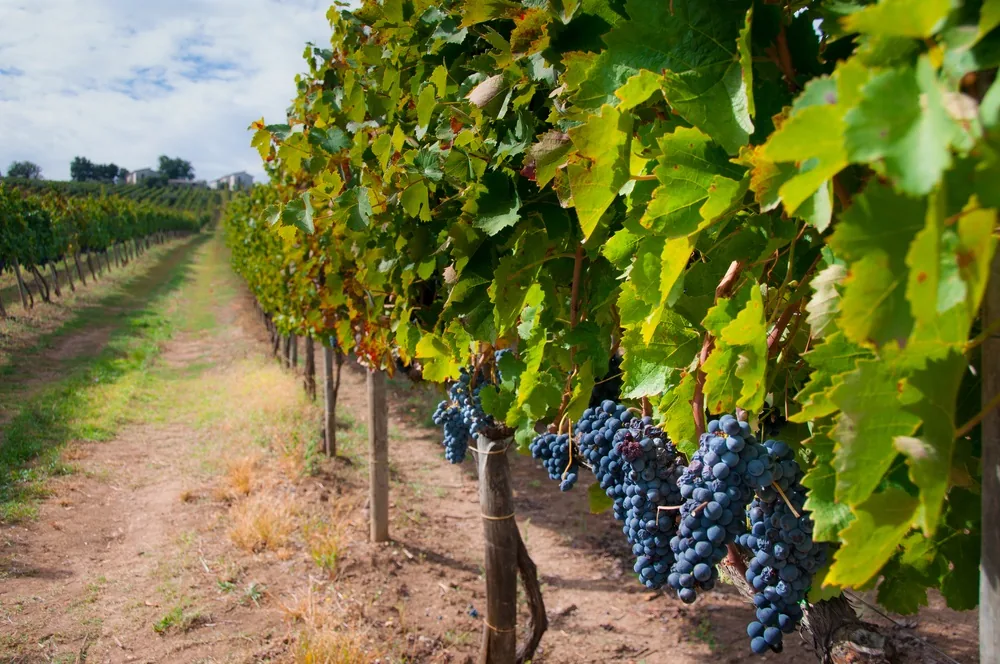
Aglianico vineyards on the volcanic slopes of Monte Vulture — basalt and tuff soils, 600 metres elevation
The History — 2,700 Years on Volcanic Soil
The Aglianico grape was brought to southern Italy by Greek colonists in the 7th century BC — approximately 700 years before the birth of Christ, at a time when the Ionian coast of what is now Basilicata was part of Magna Graecia. The name itself is a Latinization of Hellenico — the Hellenic grape. It is one of the oldest cultivated grape varieties in continuous production in Italy.
For most of its 2,700-year history, Aglianico del Vulture was a bulk wine — the grapes harvested and sold to producers throughout Italy to strengthen and deepen wines from less robust grapes. Elena Fucci's winery manager told a visiting journalist that 40% of Aglianico production has historically been sold outside the region to improve other wines, including Chianti. The local grape was scaffolding for wines that got the credit.
The transformation came slowly, beginning in the late 20th century when producers like D'Angelo and Paternoster began estate-bottling and demonstrating what the grape could do in its own right. The appellation received DOC status in 1971 and DOCG — Italy's highest wine classification — in 2010. The new generation of producers, loosely grouped under the name Generazione Vulture, has taken the reputation further still.
The Wine — What to Expect
Tasting Notes & Technical Profile
The Producers — Who to Seek Out
Elena Fucci
Contrada Solagna del Titolo · Barile (PZ)
The benchmark. Elena Fucci took over her grandfather's six hectares at age 18 in 2000, when the family was preparing to sell, and transformed a bulk-wine estate into the most awarded winery in Basilicata. Her single wine — Titolo, 100% Aglianico from the oldest vines on the estate, some over 70 years old — has received multiple Tre Bicchieri from Gambero Rosso and appeared in Wine Spectator's Top 100 Italian Wines. Visits by appointment. Elena frequently leads tastings personally. Contact: elenafuccivini.com
Tre Bicchieri Wine Spectator Top 100 Visits by appointmentPaternoster
Barile (PZ)
One of the historic estates of the Vulture appellation, Paternoster has been producing Aglianico del Vulture since the 1920s. Their Don Anselmo riserva — named after the founder — is one of the most celebrated wines in the appellation and one of the longest-lived. A benchmark for understanding what aged Aglianico del Vulture becomes with time. The winery also produces Rotondo, a more accessible entry-point wine.
Historic estate Don Anselmo riservaBasilisco
Barile (PZ)
Founded by Michele Cutolo and now under the umbrella of the Feudi di San Gregorio group. The Teodosio and Fontanelle crus consistently demonstrate the Vulture terroir at its most expressive. More commercially accessible than Fucci or Paternoster while maintaining genuine quality. Good entry point for those new to the appellation.
Fontanelle cruCantine del Notaio
Rionero in Vulture (PZ)
Named for the notarial deeds written on the labels. Gerardo Giuratrabocchetti produces wines of considerable elegance from old-vine Aglianico. Il Rogito and La Firma are the flagship labels. The winery is housed in ancient tuff caves in Rionero — one of the most atmospheric cellar visits in Basilicata. Wine tourism is well organized here.
Cellar visits available Tuff cave cellarsMusto Carmelitano
Maschito (PZ)
A small, hospitable family winery producing organic Aglianico del Vulture. Serra del Prete is their benchmark wine — precise, mineral, honest. One of the more welcoming properties for visitors without formal appointments. The organic approach to viticulture on volcanic soils produces wines of particular freshness and definition.
Organic Visitor-friendlyCantina di Venosa
Venosa (PZ)
The cooperative winery of Venosa, drawing on grapes from over 300 growers across the appellation. Not the most prestigious label but one of the most reliable for the accessible end of the market. Carato Venusio is their flagship wine. For visitors who want to taste broadly across the appellation without appointments, the Cantina di Venosa offers the most practical introduction to Aglianico del Vulture.
Cooperative Walk-in tasting Best valueMonte Vulture — Beyond the Wine
Monte Vulture is worth understanding as a landscape as well as a wine appellation. The extinct volcano — last eruption approximately 130,000 years ago — rises to 1,326 metres above sea level in the northern part of Basilicata, its crater lakes Lago Grande and Lago Piccolo di Monticchio sitting in the caldera. The slopes support chestnut and oak forests at higher elevations, vineyards on the middle slopes at 200-700 metres, and the towns of Rionero in Vulture, Barile, Melfi, and Venosa around the base.
Melfi — the most historically significant town on the Vulture — sits 531 metres above sea level with a Norman castle that was one of the most important fortresses in medieval southern Italy. Frederick II held councils here. The castle now houses a museum with one of the finest collections of ancient finds in Basilicata. The town itself retains its medieval street plan and is undervisited relative to its historical significance.
Venosa is the birthplace of Horace — the Latin poet Quintus Horatius Flaccus, born in 65 BC — and one of the most layered towns in Basilicata. The Incompiuta, the unfinished Norman church begun in the 11th century and abandoned with the apses still open to the sky, is one of the most unusual medieval buildings in the south. The Jewish catacombs of Venosa are among the most significant traces of Jewish presence in ancient southern Italy. The Cantina di Venosa is here.
Planning a Monte Vulture Wine Visit
Melfi & Venosa — What to See
Melfi
MONTE VULTURE ZONE
Norman castle — one of the most important medieval fortresses in southern Italy. Frederick II held councils here. Museum with excellent ancient collection. Medieval street plan intact. Undervisited relative to its historical significance.
Territory Guide →Venosa
MONTE VULTURE ZONE
Birthplace of Horace (65 BC). The Incompiuta — unfinished Norman church open to the sky. Jewish catacombs. Archaeological park. One of the most layered towns in Basilicata and the most overlooked.
Territory Guide →Frequently Asked Questions
What is Aglianico del Vulture? +
A red wine DOCG from Basilicata made exclusively from the Aglianico grape grown on the volcanic slopes of Monte Vulture. The grape was introduced by Greek colonists around 700 BC. Known for deep color, firm tannins, high acidity, and exceptional aging potential. Critics compare it to Barolo in structure and complexity. The price is significantly lower.
Who are the best Aglianico del Vulture producers? +
Elena Fucci (Barile) is the benchmark — her Titolo has received multiple Tre Bicchieri from Gambero Rosso and appeared in Wine Spectator's Top 100. Other excellent producers: Paternoster (historic, Don Anselmo riserva), Basilisco, Cantine del Notaio (cave cellars, visitor-friendly), Musto Carmelitano (organic), Cantina di Venosa (cooperative, best for walk-in tasting).
How do I visit Elena Fucci winery? +
Visits by appointment only — contact at elenafuccivini.com. Located in Contrada Solagna del Titolo, Barile. Elena frequently leads tastings personally. Book at least 1-2 weeks in advance. Worth planning your Basilicata itinerary around.
When should I drink Aglianico del Vulture? +
The minimum aging is 9 months (DOC) or 5 years (Superiore DOCG). For the benchmark producers, the wine rewards significant patience — 5-10 years is ideal for good vintages. In youth the tannins are firm and austere; with age the wine opens to dried fruit, leather, volcanic minerals, and complex tertiary notes. Decant young wines 2+ hours before serving.
Is Monte Vulture worth visiting without wine interest? +
Yes — the Vulture zone has significant independent interest. Melfi's Norman castle is one of the most important medieval fortresses in southern Italy. Venosa is the birthplace of Horace and has the extraordinary Incompiuta church. The crater lakes of Monticchio are beautiful. The entire northern Basilicata zone is genuinely undervisited and rewards the curious traveler.